
Buying Guides
Best Rowing Machine for Home: UK Buying Guide 2026
Oct
Choosing the best rowing machine for home comes down to three things: the type of resistance (air, magnetic or water), the space you have, and how hard you want to train. For most people who want a tough, full-body workout that lasts for years, an air rower is the best all-round choice: the harder you pull, the harder it gets, and it is the type you will find in gyms, CrossFit boxes and HYROX races. If you live in a flat and need near-silent training, a magnetic rower is the better fit.
This UK buying guide explains how each type works, what muscles a rowing machine works, how much space you need, and what to check before you buy.
Last updated 8 October 2026 by the ADVG Team. ADVG sells the air rower and the bundles linked in this guide. How we wrote this guide.
Which rowing machine should you buy? The quick answer
- Air rower: best for fitness, HIIT, CrossFit and HYROX training. Smooth, unlimited resistance, with some fan noise.
- Magnetic rower: best for flats and early-morning training. Very quiet, but you set the resistance on a dial rather than with your effort.
- Water rower: best if you love the look and the swoosh of real water. Heavier and usually dearer, and the tank needs occasional care.
- Hydraulic (piston) rower: the cheapest and most compact, but the stroke is less smooth and feels least like real rowing.
Is a rowing machine a good workout?
Yes. A rowing machine trains your whole body and your heart and lungs at the same time, without the impact of running. Each stroke starts with a powerful leg drive, your core and back pass that force through, and your arms finish the pull: British Rowing puts the split at about 60% legs, 30% body and 10% arms. Because you are seated with your feet strapped in, there is very little pounding on your knees and ankles, which is why British Rowing calls indoor rowing a low-impact activity.
For general health, the American College of Sports Medicine recommends that adults do at least 150 minutes of moderate activity or 75 minutes of vigorous activity a week. Four hard 20-minute rowing sessions, or three of 25 minutes, cover the vigorous target.
What muscles does a rowing machine work?
- Legs: your quads, glutes and hamstrings drive the stroke. Most of your power comes from here.
- Back: your lats, rhomboids and the muscles along your spine hold your posture and pass the leg drive to the handle.
- Core: your abs and obliques brace through every stroke and control the swing forward.
- Arms and shoulders: your biceps, forearms and rear shoulders finish the pull and control the return.
Does a rowing machine work your abs?
Yes, as stabilisers rather than as an isolation exercise. Your abs brace to keep your back straight and help you rock forward into the next stroke, so regular rowing builds a strong core with plenty of endurance. If you want visible abs, pair rowing with core work and a sensible diet.
Air vs magnetic vs water rowing machines
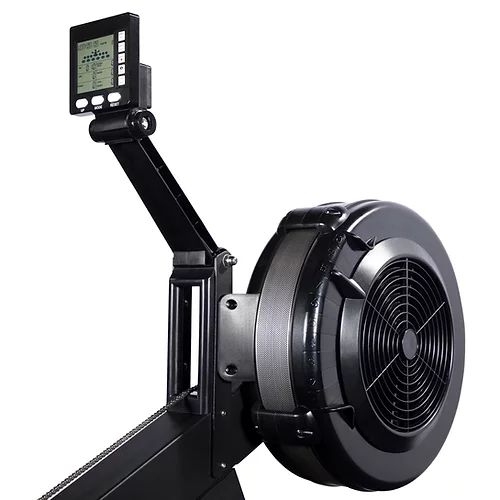
The biggest choice is how the machine creates resistance. It changes how the stroke feels, how loud the rower is and what kind of training it suits.
| Type | How the resistance works | Noise | Best for | Good to know |
|---|---|---|---|---|
| Air | A fan flywheel: the harder you pull, the more air it moves and the harder it gets. A damper changes the feel. | A steady whoosh | Fitness, HIIT, CrossFit, HYROX, gyms | Unlimited resistance; very durable; the gym standard |
| Magnetic | Magnets beside the flywheel; you choose a level on a dial or the console. | Very quiet | Flats, shared homes, steady cardio | Resistance does not rise with your effort as naturally; some models fold away |
| Water | Paddles turn inside a water tank. | A soft swoosh | A natural feel and a wooden look | Heavier; the tank needs purification tablets now and then |
| Hydraulic | Pistons under the arms or the rail. | Quiet | Very small spaces and tight budgets | Less smooth; feels least like real rowing |
What does the damper on an air rower do?
The damper, usually numbered 1 to 10, controls how much air reaches the fan. A low setting feels like a light, fast boat and a high setting feels like a heavy boat that is slow to get moving. A higher number is not more workout. British Rowing compares the damper to the gears on a bike and suggests keeping it at 4 or below, so your legs, body and arms all do their share, and Rowing Australia notes that many rowers sit around 3 to 5. The damper on our air rower runs from 1 to 10.
What to look for when buying a rowing machine
- Resistance type: air for intensity, magnetic for quiet (see the table above).
- The monitor: it should show time, distance in metres, strokes per minute and calories at the very least. Bluetooth and heart-rate connection make it easier to track your progress.
- Rail length and seat height: taller rowers need a long monorail to reach full leg extension, and a higher seat is easier to get on and off.
- Footprint and storage: most full-size rowers are around 2.4 m long. Measure your room before you buy.
- Build quality: a solid rail, a smooth seat and good bearings make a big difference to how a rower feels after a year of use.
- Warranty and support: look for at least a 2-year warranty and a UK seller you can actually talk to.
How much space do you need for a rowing machine?
Our air rower is 245 cm long and 60 cm wide. Allow a clear area of roughly 2.7 m by 1.2 m so you can step on and off safely. Ceiling height is not an issue, which makes rowers a good fit for garages, spare rooms and garden gyms.
The ADVG air rower
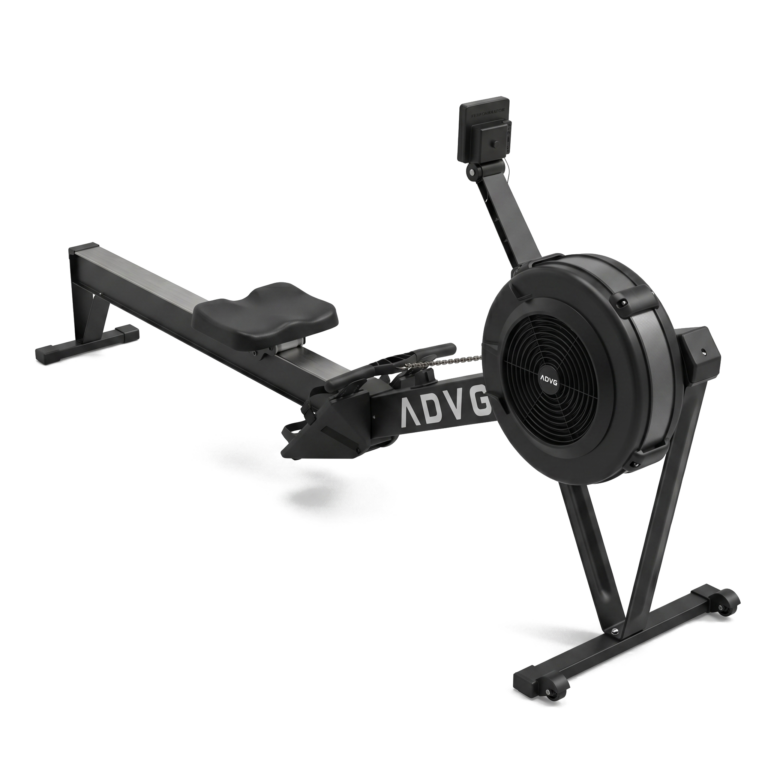
Our ADVG RowErg PowerMax 1.0 is an air rowing machine made for home gyms and busy gym floors alike.
- Air resistance: smooth, unlimited resistance that rises with your effort, with a damper from 1 to 10.
- Performance monitor: time, distance in metres, strokes per minute, calories, strokes and total strokes, plus 20/20 and 10/20 interval modes.
- Heart-rate and Bluetooth connection: pair a heart-rate monitor and keep track of every session.
- Size: 245 cm long and 60 cm wide, with a 136 cm monorail and a 35 cm seat height.
- Weight: 25 kg, so it is easy to move around.
- Storage: it collapses for storage, so it takes up less floor space between workouts.
- Power: the monitor runs on a battery, so there is nothing to plug in.
- In the box: it arrives in one box of 145 x 53 x 38 cm, small enough to carry through a standard doorway.
- Warranty: 2 years, covering manufacturing defects.
Two practical questions customers ask us about it are whether it folds away and whether it needs a socket: the answers are in the list above. Reviews on its product page mostly mention how solid it feels and how easy it is to put together: one buyer had it built in about 20 minutes.
See the ADVG air rower
Rower bundles
Building a complete cardio corner? Our bundles pair the rower with the other machines people train on most:
- ADVG SkiErg RowErg Bundle: the two machines used in a HYROX race.
- ADVG RowErg AirBike Bundle: rowing plus a fan bike for hard intervals.
- ADVG Tri-Erg Bundle: ski, bike and row in one order.
How to row: the four parts of the stroke
- Catch: sit tall at the front of the rail with your shins upright and your arms straight.
- Drive: push with your legs first, then swing your body back slightly, then pull the handle to your lower ribs.
- Finish: legs straight, shoulders slightly behind your hips, handle just below your chest.
- Recovery: reverse the order: arms away, body forward, then bend your knees and slide back to the catch.
This is the order British Rowing teaches: legs, body, arms on the drive and arms, body, legs on the way back. For a step-by-step version with photos, see the CrossFit Journal’s rowing technique guide.
Two rowing workouts to try
- Steady 20: row for 20 minutes at a pace where you can still talk in short sentences. Note your distance and try to beat it next week.
- Row and swing: three rounds of a 1,000 m row and 20 dumbbell swings with a 10 kg dumbbell. Rest two minutes between rounds.
For more ideas, the CrossFit Journal’s rowing workouts include intervals, relays and a session that changes the damper as you go.
Customer care and warranty
- 2-year warranty on the rower, covering manufacturing defects: see the warranty terms in our returns and warranty policy.
- 30-day return window from the day your order is delivered: see our returns policy.
- Help choosing: not sure which machine suits your space? Contact us.
Frequently asked questions
Is 20 minutes on a rowing machine enough?
Yes. Twenty minutes three or four times a week is enough to improve your fitness. If those sessions leave you breathing hard, four of them meet the 75 minutes of vigorous activity a week that the American College of Sports Medicine recommends for adults.
Is a rowing machine good for weight loss?
Rowing uses most of the muscles in your body, so it burns a lot of energy in each session, and it is low impact, so you can train often. Combined with a sensible diet, regular rowing is an effective way to lose weight.
Are air rowers loud?
An air rower makes a steady whoosh from its fan that gets louder the harder you row. It is fine in a garage, a gym or most houses; in a flat, a magnetic rower is quieter.
What damper setting should I use on an air rower?
Around 3 to 5 suits most workouts, and British Rowing suggests keeping it at 4 or below. Higher settings feel heavier but do not give you a better workout, and they make it harder to share the work between your legs, body and arms.
Can tall people use a rowing machine?
Yes, as long as the monorail is long enough for your legs to straighten fully at the end of each stroke. Check the rail length before you buy: the ADVG air rower’s monorail is 136 cm long.
Can a rowing machine be stored away?
Yes. Many air rowers, ours included, collapse for storage so they take up less floor space between workouts, and some magnetic rowers fold upright. Measure the space it needs in use too: ours is 245 cm long.
Rowing machine or exercise bike: which is better?
A rowing machine works your upper body as well as your legs, so it trains more muscle in each session. A bike is easier to learn and lets you train hard without any technique. Many home gyms have both.
Conclusion
For most UK home gyms, an air rowing machine gives you the most workout for your money and your floor space: full-body training, no impact, and resistance that keeps up as you get fitter. Pick a magnetic rower if quiet matters more than intensity.
Ready to start? See the ADVG air rower, or read our guides to HYROX training at home and curved vs flat treadmills.
How we wrote this guide
- What it is based on: the specifications of the air rower we stock, from its product page; the reviews on that page; the questions customers ask us by chat and email; and the published sources below, each read and checked on 8 October 2026.
- What we have not done: we have not run laboratory or noise tests. The workouts are examples for healthy adults, not a personal training plan.
- Our interest: ADVG sells the air rower and the bundles linked in this guide. We do not sell magnetic, water or hydraulic rowers, so we have said plainly when one of those suits you better, and we have not named or ranked other brands.
- Corrections: spotted something wrong or out of date? Tell us and we will put it right.
Sources
- British Rowing, British Rowing Technique: the legs, body, arms sequence and the 60/30/10 split of power.
- British Rowing, Perfect Your Technique: the damper works like a bike’s gears; keep it at 4 or below.
- British Rowing, Why Go Row Indoor: indoor rowing is low impact.
- Rowing Australia (Row Nation), The damper is not a difficulty knob: a higher damper is not a harder workout; many rowers use 3 to 5.
- American College of Sports Medicine, Physical Activity Guidelines: 5 FAQs: 150 minutes of moderate or 75 minutes of vigorous activity a week.
- Angela Hart, CrossFit Journal (2006), Rowing Technique: the stroke step by step.
- Angela Hart, CrossFit Journal (2007), Rowing Workouts: further rowing sessions.
About the ADVG Team
ADVG is a UK fitness equipment brand that has supplied commercial-grade gym equipment since 2021: curved treadmills, rowers, ski ergs, air bikes, stair climbers and weights for home gyms, studios and commercial gyms. We deliver from UK stock held in our Cardiff warehouse, and you can call or chat to book a visit to see the machines in person. We answer customers’ questions by chat, email and phone before and after they buy, and our guides are written around the questions we hear most. ADVG is a brand of Belgrave Fitness Ltd (company number 16106337).
