
Buying Guides
Curved Treadmill vs Flat Treadmill: UK Buying Guide
Oct
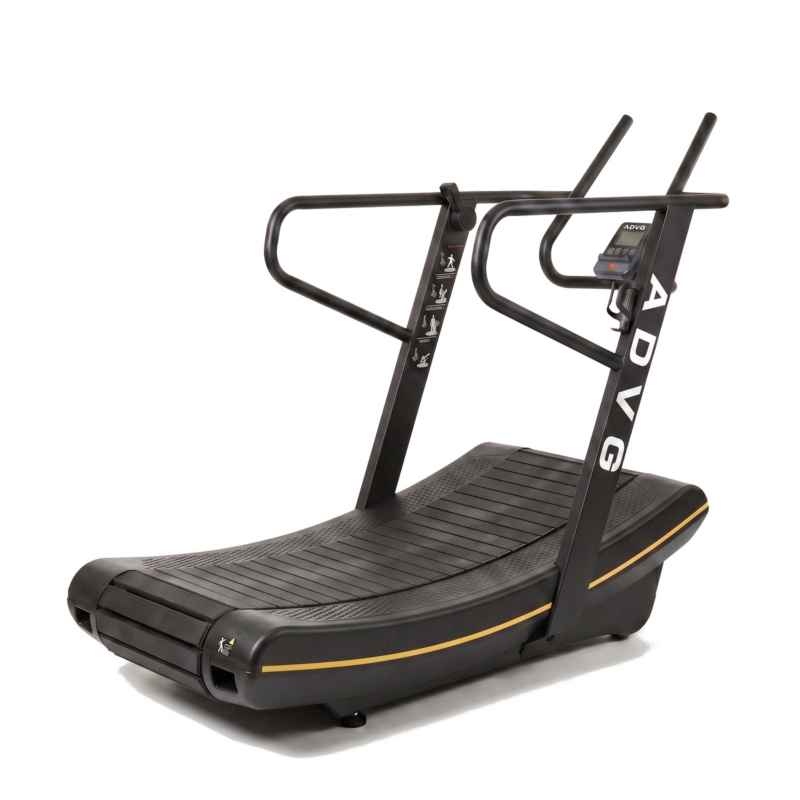
A curved treadmill has no motor. The belt only moves when you push it, and the curved deck lets you speed up by moving forward and slow down by drifting back. Compared with a flat, motorised treadmill it gives a harder workout at the same speed and has no top speed, which makes it ideal for sprints, HIIT and HYROX training. A flat treadmill is the better choice for long, easy walks, built-in programmes and incline work.
This UK guide compares the two, explains what the research says, and covers what to check before you buy.
Last updated 8 October 2026 by the ADVG Team. ADVG sells the CurveMax curved treadmill featured in this guide, and no flat treadmills. How we wrote this guide.
Curved vs flat treadmill at a glance
| Curved (self-powered) | Flat (motorised) | |
|---|---|---|
| What moves the belt | You do | A motor |
| How you change speed | Move forward or back on the curve | Buttons on the console |
| Top speed | As fast as you can run | Set by the motor |
| Effort at the same speed | Noticeably higher | Similar to running outside |
| Best for | Sprints, intervals, HIIT, HYROX, athletes | Walking, steady jogs, programmes, incline |
| Running surface | Slats on bearings | A belt over a deck |
| Power needed | None: the console runs on batteries | A mains socket |
| Upkeep | No motor to wear out | Motor, belt and deck need care over time |
| Price | Higher | Wide range |
How does a curved treadmill work?
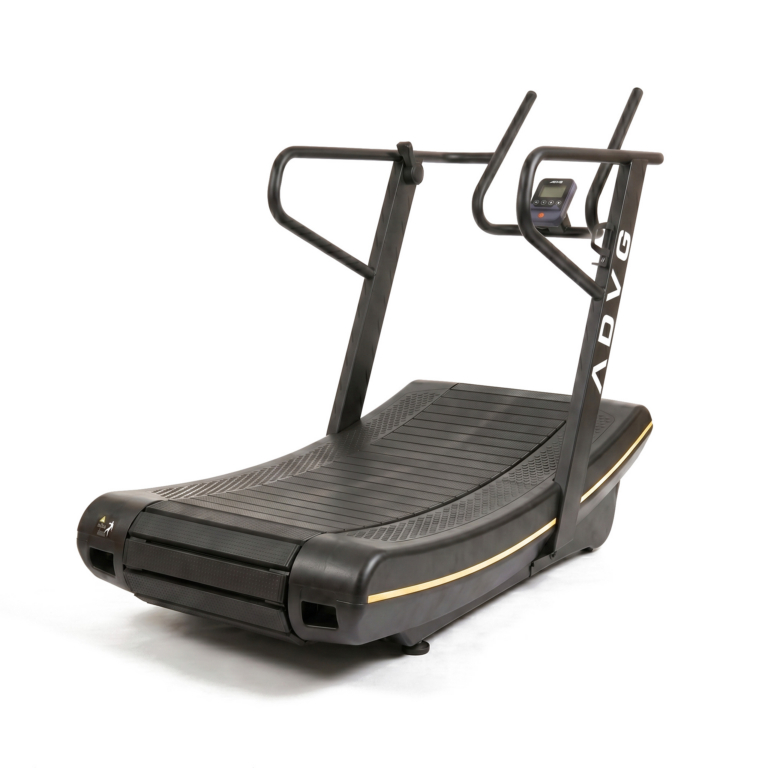
The running surface is made of slats that roll on bearings around a curved frame. When your foot lands on the front of the curve, your push and your body weight drive the slats backwards. Run further up the front of the curve and the belt speeds up; drift back towards the lowest point and it slows down. There are no buttons to press, so you can go from a walk to a flat-out sprint in a couple of strides. As sprint coach Derek Hansen told ACE, a motorised treadmill drives you, while on a manual one you drive the belt.
Many curved treadmills also have adjustable resistance. The ADVG CurveMax has 8 levels of magnetic resistance: low levels feel like running on a track, and high levels make every stride a drive, close to pushing a sled.
The benefits of a curved treadmill
- A harder workout in less time: in a 2016 study, running on a non-motorised curved treadmill took about 37% more oxygen and raised heart rate by about 22% compared with a motorised treadmill or a track at the same speeds. The researchers suggest running about 4 km/h slower on a curved treadmill to get the same effort (Wee, von Heimburg and van den Tillaar, 2016). Later studies agree: Edwards and colleagues (2017) and Schoenmakers and Reed (2018) both found higher oxygen use, heart rate and perceived effort than on a motorised treadmill at the same speed.
- Instant speed changes and no top speed: perfect for sprint intervals, where a motor would slow you down while it catches up. Sports scientists use curved treadmills for self-paced sprint and team-sport tests for the same reason.
- Running form: the evidence is mixed. One small study saw most runners switch from a heel strike outdoors to a mid-foot strike on a curved treadmill (described in Schoenmakers and Reed, 2018), while a 2021 study found the treadmill made no difference to stride timing compared with a motorised one.
- Less shock through your legs: that 2021 study also measured lower impact accelerations at the shin and head on a curved treadmill than on a motorised treadmill. No study has yet shown that this means fewer injuries.
- Strength as well as cardio: high resistance settings make every stride a hard push. BarBend lists treadmill pushes among its sled push alternatives, and on a curved treadmill you can set the resistance.
- Built to last: with no motor, there is less to go wrong.
The downsides to know about
- Price: curved treadmills cost more than most home motorised treadmills.
- Weight: they are heavy (our CurveMax weighs 176 kg), so plan for delivery access and a ground-floor space.
- A short learning curve: holding a steady pace takes a few sessions to get used to.
- No programmes or incline: if you mostly walk while watching TV, or want pre-set incline workouts, a flat motorised treadmill suits you better.
Which treadmill is best for home?
Choose a curved treadmill if you train for performance, sprinting, HIIT or HYROX, want to work harder in less time, and have a ground-floor space for a heavy machine.
Choose a flat motorised treadmill if you mainly walk or jog at a steady pace, want built-in programmes or incline, or need something that folds away.
What to look for in a curved treadmill
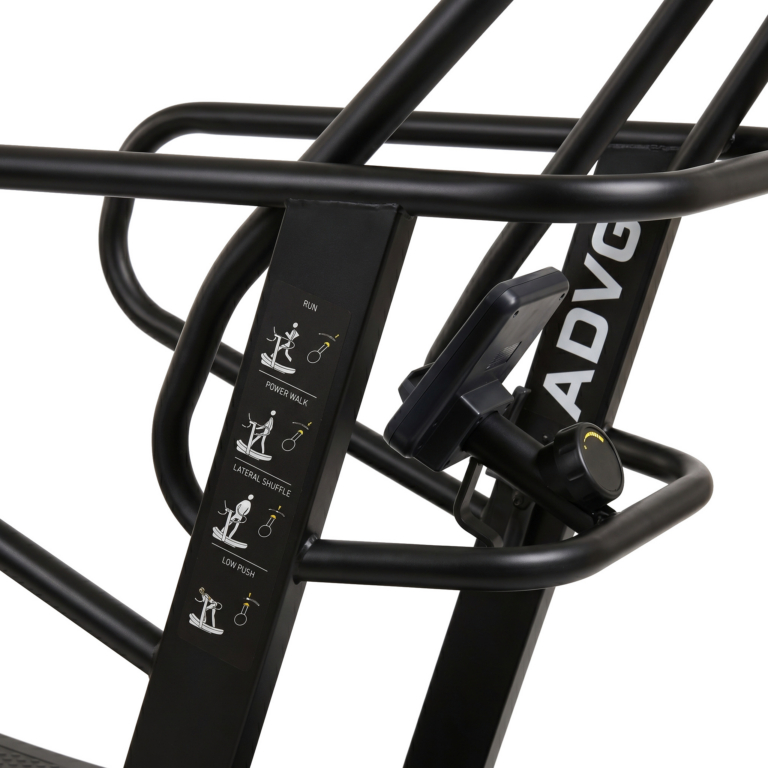
- The slat belt and bearings: they take every stride, so they decide how smooth and quiet the treadmill feels for years.
- Resistance levels: more levels give you more ways to train, from easy runs to sled-style pushes.
- Running surface: a longer, wider surface feels safer when you sprint.
- Maximum user weight and height range: check both against everyone who will use it.
- Size, weight and step-up height: measure your space and the route into it.
- Warranty: look for at least two years.
The ADVG CurveMax 1.0 curved treadmill
The ADVG Commercial Curved Treadmill CurveMax 1.0 is a commercial-grade, self-powered curved treadmill, available with a yellow stripe or in all black.
- Resistance: magnetic, with 8 adjustable levels.
- Power: the console runs on batteries, so there is nothing to plug in.
- Running surface: 1679 x 479 mm.
- Size: 1905 x 885 x 1545 mm (L x W x H), with the belt about 35 cm off the ground.
- Weight: 176 kg.
- Users: up to 179 kg, from 151 cm to 209 cm tall.
- Extras: water bottle holder and phone holder.
- Warranty: 24 months, covering manufacturing defects.
Delivery, set-up and the questions buyers ask us
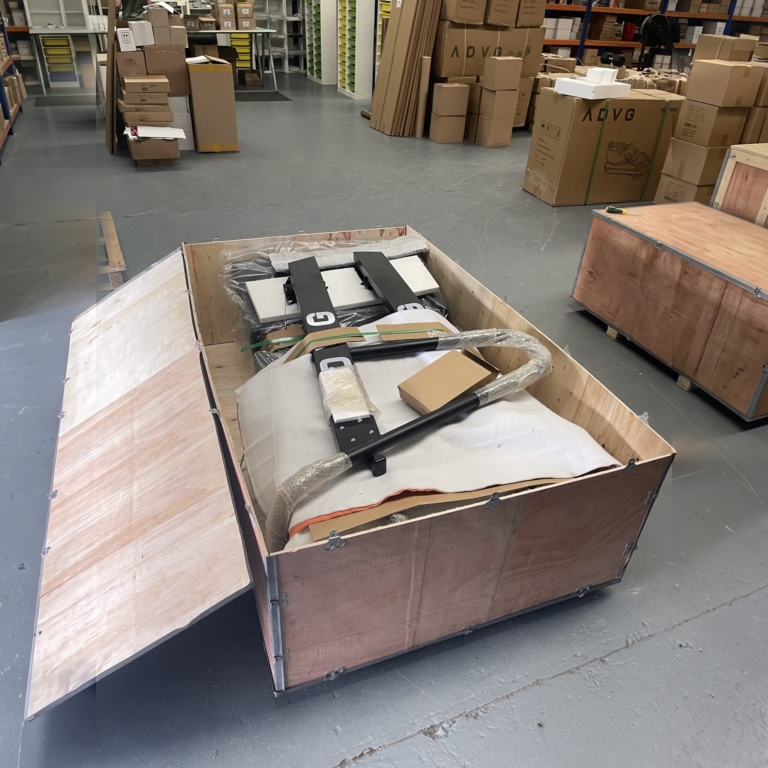
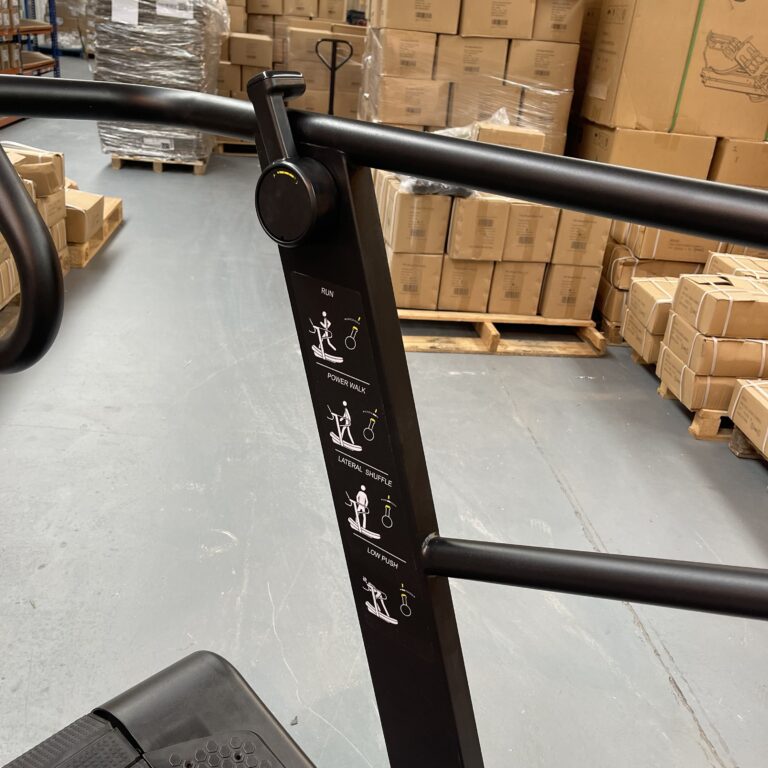
The photo shows a CurveMax in its shipping crate in our warehouse. These are practical questions customers often ask us before they buy:
- Does it come assembled? Mostly. It arrives about 80% built, and you fit the handrails and the console. Reviews on its product page describe assembly as easy, and we can talk you through it.
- How is it delivered? On a pallet, in a wooden crate about 2 m long, by a lorry with a tail-lift. Pallet drivers deliver to the kerb, and the crate takes at least four people to move, so have help ready.
- Will it fit through my door? Measure the route first, including doorways, corners and steps. The treadmill is 885 mm wide, so a narrow doorway means tilting it; never lift it by its plastic covers.
- Does it need a power socket? No. There is no motor, and the console runs on batteries, so it can go anywhere with a solid, level floor.
- Does it fold? No, but the wheels and handle at the back let you move it around once it is set up.
Buyers include gyms and bootcamp coaches as well as home users. You can also watch one in action on our YouTube channel.
See the ADVG CurveMax 1.0, or read more about why its steep curve matters.
How to get used to a curved treadmill
- Start by walking while holding the handrails, and feel how the belt moves when you step further up the curve.
- Find your sweet spot: the place on the curve where the speed feels steady.
- Speed up by moving forward up the curve, and slow down by drifting back towards the lowest point.
- Keep sessions short at first: the extra effort catches most people out in their first week.
A curved treadmill workout to try
Four rounds, resting two minutes between rounds:
- 400 m run on a low resistance setting.
- 15 kettlebell swings.
- 100 m sled-style push on a high resistance setting, driving hard through your legs.
Customer care and warranty
- 24-month warranty, covering manufacturing defects or quality issues: see the warranty terms in our returns and warranty policy.
- 30-day return window from the day your order is delivered: see our returns policy.
- Help choosing: not sure about delivery access or space? Contact us.
Frequently asked questions
Are curved treadmills better than normal treadmills?
For intense running, sprints and HIIT, yes: a curved treadmill gives a harder workout at the same speed and has no top speed. For walking, steady jogging, programmes and incline, a normal motorised treadmill is the better choice.
Is running on a curved treadmill harder?
Yes. A 2016 study found that running on a curved non-motorised treadmill took about 37% more oxygen and raised heart rate by about 22% compared with a motorised treadmill at the same speed, and later studies found the same pattern.
Can you walk on a curved treadmill?
Yes. Stay near the lowest point of the curve and hold the handrails while you get used to it, and the belt moves at walking pace.
Is a curved treadmill good for HYROX training?
Yes. You set the pace with your stride, as you do in the race, and a high resistance setting gives you a hard, sled-style push. Practise with a real sled at a gym before race day too.
How heavy is a curved treadmill?
Commercial curved treadmills are heavy: the ADVG CurveMax 1.0 weighs 176 kg, so check the delivery route and plan for a ground-floor space.
Is a curved treadmill good for beginners?
Yes, if you start slowly. Begin with short walking and jogging sessions, hold the handrails at first, and expect each run to feel harder than the same pace on a normal treadmill.
Conclusion
If you want the most intense running workout in the least time, with no motor, no top speed and nothing to plug in, a curved treadmill is the better buy. If you mainly walk or want programmes and incline, choose a flat motorised treadmill.
See the ADVG CurveMax 1.0, or read our guides to HYROX training at home and choosing a rowing machine.
How we wrote this guide
- What it is based on: the specifications of the CurveMax we stock, from its product page; reviews on that page; the questions customers ask us by chat and email; and the published studies and articles below, each read and checked on 8 October 2026.
- What we have not done: we have not run our own laboratory tests. The figures on oxygen use, heart rate and impact come from the studies cited, which tested small groups of runners on other makes of curved treadmill, not on our CurveMax.
- Our interest: ADVG sells the CurveMax curved treadmill and no flat treadmills, so we have said plainly when a flat motorised treadmill is the better choice, and we have not named or ranked other brands.
- Corrections: spotted something wrong or out of date? Tell us and we will put it right.
Sources
- Wee, von Heimburg and van den Tillaar (2016), Comparison of perceptual and physiological variables of running on a track, motorized treadmill, and non-motorized curved treadmill at increasing velocity, Acta Kinesiologiae Universitatis Tartuensis: 37% more oxygen, 22% higher heart rate, about 4 km/h slower for the same effort.
- Edwards, Tofari, Cormack and Whyte (2017), Non-motorized treadmill running is associated with higher cardiometabolic demands compared with overground and motorized treadmill running, Frontiers in Physiology: higher oxygen use and heart rate.
- Schoenmakers and Reed (2018), The physiological and perceptual demands of running on a curved non-motorised treadmill: implications for self-paced training, Journal of Science and Medicine in Sport: higher oxygen use, heart rate and perceived effort; the change in foot strike.
- Encarnación-Martínez and colleagues (2021), Treadmill and running speed effects on acceleration impacts: curved non-motorized treadmill vs. conventional motorized treadmill, International Journal of Environmental Research and Public Health: lower impact accelerations, no change in stride timing.
- Tofari, McLean, Kemp and Cormack (2015), A self-paced intermittent protocol on a non-motorised treadmill, Journal of Sports Science and Medicine: curved treadmills for self-paced sprint testing.
- ACE, Branch Out With Cardio Equipment (2018): how a manual curved treadmill works.
- BarBend, Sled Push Alternatives: treadmill pushes as a stand-in for the sled push.
About the ADVG Team
ADVG is a UK fitness equipment brand that has supplied commercial-grade gym equipment since 2021: curved treadmills, rowers, ski ergs, air bikes, stair climbers and weights for home gyms, studios and commercial gyms. We deliver from UK stock held in our Cardiff warehouse, and you can call or chat to book a visit to see the machines in person. We answer customers’ questions by chat, email and phone before and after they buy, and our guides are written around the questions we hear most. ADVG is a brand of Belgrave Fitness Ltd (company number 16106337).
